Research
Centromeres across eukaryotes
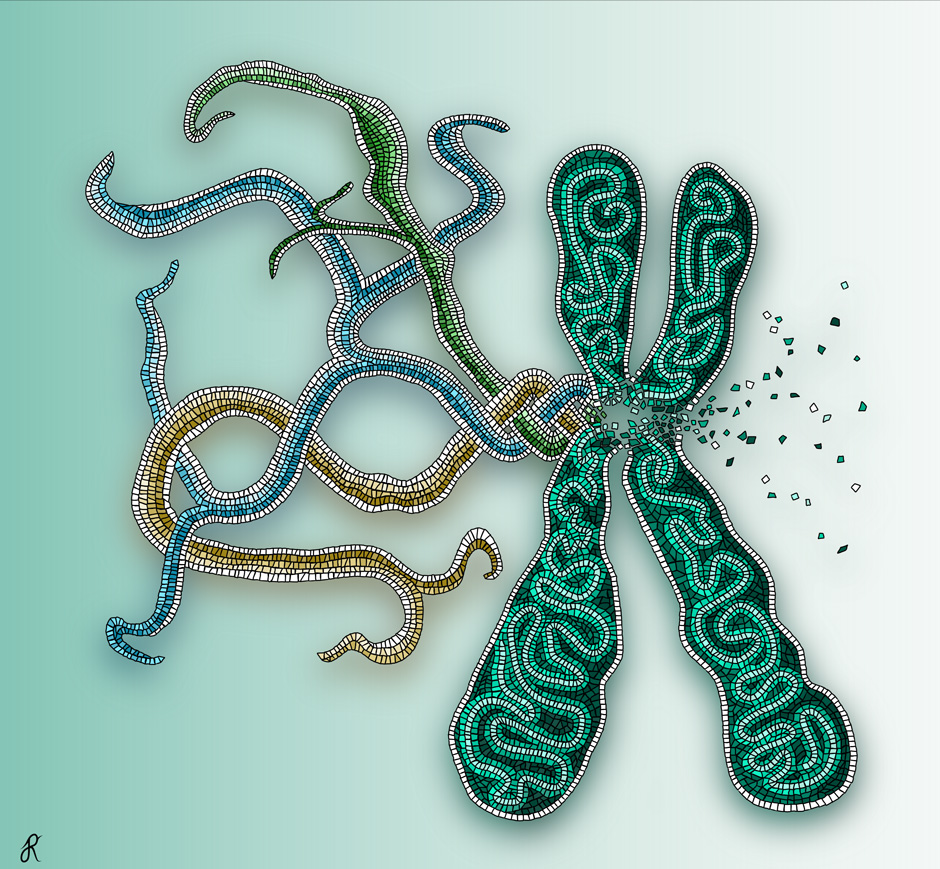
As attachment points for the segregation machinery, centromeres are crucial for ensuring that an organism’s genetic material is segregated rapidly and reproducibly during mitosis and meiosis. Despite their crucial role, centromeres are also one of the fastest evolving regions of the genome.
We are interested in the dynamics of centromere evolution across eukaryotes, both in well-known models such as yeasts, as in microbes with more limited information on centromere identity such as red and green algae and diatoms.
Speciation and centromeres
As centromeres evolve very fast, they could in time become too different to function as efficient attachment points for the segregation machinery in cells of closely related organisms.
We are interested in learning how centromere evolution contributes to the emergence of new species, both by exploring natural diversity to see what has happened, as well as by replaying evolution in the lab to see what can happen.

Centromere-kinetochore coevolution
To better understand how stable connections between chromosomes and the division machinery are established, natural variation in centromeres needs to be linked to variation in centromere-binding proteins.
By combining comparative approaches with functional assays, we aim to uncover the core principles of centromere-kinetochore coevolution during both mitosis and meiosis.
Synthetic chromosomes
While explorative and comparative analyses can be very powerful, they are correlative by nature. To empirically test centromere function, compatibility and evolution in the lab, we are establishing a synthetic chromosome system.